Why Millets Disappeared from Indian Plates and Why They Are Coming Back
For most of Indian history, jowar, bajra, ragi, and barley were staple foods. The Green Revolution replaced them with wheat and rice almost overnight. Fifty years later, research on diabetes, gut health, and climate resilience is bringing millets back to the centre of the conversation.

For most of recorded Indian history, the staple grains on most plates were not wheat and rice. They were jowar, bajra, ragi, and barley - millets that had been cultivated on the subcontinent for five to eight thousand years. These grains shaped Indian cooking, Indian agriculture, and the nutritional profile of the Indian diet across millennia.
In less than three decades, between roughly 1965 and 1995, millet cultivation in India collapsed. The Green Revolution - which brought high-yield wheat and rice varieties, subsidised irrigation, and government procurement focused on these two crops - made millets economically unviable for most farmers almost overnight. A dietary shift that had taken thousands of years to develop was reversed in a generation.
The consequences of that shift are now part of the public health conversation in India. And the reversal - driven by research, by changing consumer awareness, and by a government that declared 2023 the International Year of Millets - is underway.
What Was Lost When Millets Disappeared
Millets are nutritionally distinct from wheat and white rice in several important ways. They are naturally gluten-free. They have a lower glycaemic index than refined wheat or polished rice. They contain higher levels of certain minerals - particularly calcium in ragi, iron in bajra, and magnesium across most varieties. And they are rich in insoluble fibre that supports gut health and sustained energy release.
| Millet | Also Known As | Key Nutrients | Best For |
|---|---|---|---|
| Ragi | Finger millet, nachni | Highest calcium of any grain - 344mg per 100g; iron; amino acid methionine | Daily rotis, porridge for babies and elderly, baked goods |
| Jowar | Sorghum | Protein, fibre, B vitamins, antioxidants, naturally gluten-free | Bhakri, thalipeeth, rotis, porridge, gluten-free baking |
| Bajra | Pearl millet | Iron, magnesium, phosphorus, high protein for a grain, warming in nature | Winter rotis, khichdi, bajra kheer, well-suited for diabetes management |
| Barley | Jau | Beta-glucan (soluble fibre that reduces LDL cholesterol), selenium, B vitamins | Soups, khichdi, porridge, water (jau ka pani), barley flour rotis |
Ragi: The Calcium Grain
Ragi contains more calcium per 100g than any other grain - more than milk on a per-gram basis - making it an exceptionally valuable food for populations with low dairy intake, for children in critical bone-building years, and for women approaching or past menopause. It also contains the amino acid methionine, which is lacking in most other plant foods.
Stone-ground ragi flour integrates naturally into everyday Indian cooking. Ragi rotis have a distinctive earthy flavour that most households adjust to within a week. Ragi porridge - ragi kanji or ragi mudde - has been a traditional weaning food and elderly care food across South India for generations. Our ragi waffles with ghee and coconut milk offer a contemporary format that works for the whole family.
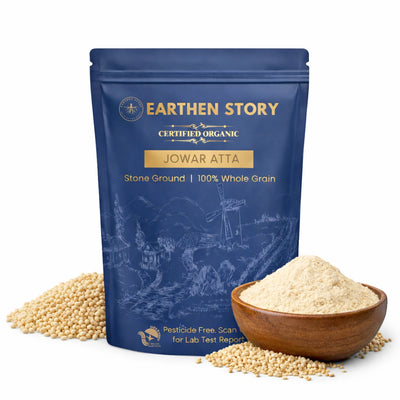
Jowar: The Gluten-Free Staple
Jowar is the millet most naturally suited to replacing wheat in everyday cooking. Its flavour is mild, its texture when ground into flour is workable, and it produces rotis and bhakri that are familiar to most palates. For the growing number of people managing gluten sensitivity or simply wanting to reduce wheat dependence, organic jowar flour is the most practical starting point.
Jowar is also one of the most climate-resilient crops grown in India - it thrives in low-rainfall conditions and poor soils where wheat cannot grow. Its displacement by wheat in the Green Revolution was a nutritional and ecological loss simultaneously. The jowar thalipeeth - a traditional Maharashtrian flatbread - is one of the most satisfying ways to reintroduce it.
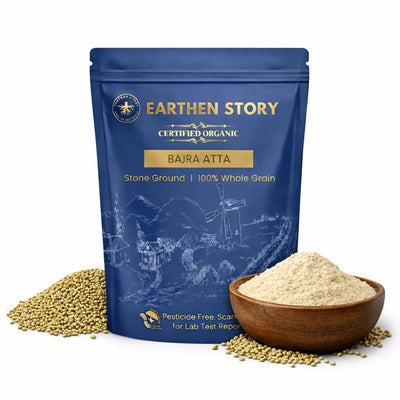
Bajra: The Winter Grain
Bajra has the highest iron content of the major millets and is particularly warming in nature - traditional Rajasthani and Haryanvi diets used bajra rotis as the primary winter staple for good reason. Its high magnesium content supports sleep quality and muscle recovery, and its low glycaemic index makes it relevant for the growing population managing type 2 diabetes or insulin resistance.
Organic bajra flour produces rotis with a slightly dense, hearty texture that pairs well with robust winter vegetables, mustard greens, and robust dals. Bajra khichdi - bajra cooked with moong dal and ghee - is one of the simplest and most complete one-pot meals in the Indian repertoire.
Barley: The Forgotten Digestive
Barley was a dietary staple across North India before wheat displaced it. Its defining nutritional characteristic is beta-glucan - a soluble fibre with one of the strongest evidence bases of any dietary compound for reducing LDL cholesterol. The EU permits health claims on beta-glucan specifically because the research is that consistent.
Barley flour can be mixed with wheat flour for rotis, used in soups and khichdi, or drunk as jau ka pani - the traditional barley water that has been used as a digestive and cooling drink across India for centuries. Barley atta health benefits are real and clinically supported, not traditional folklore.
How to Start
The most common mistake when reintroducing millets is trying to replace wheat entirely and immediately. The texture difference is real and the adjustment takes time. A better approach: start with a 30-70 blend of millet flour and whole wheat flour in your roti dough. Over four to six weeks, shift the ratio gradually toward more millet. By the time you reach 50-50, the flavour will be familiar and the adjustment effortless.
For the nutritional context on why whole grain stone-ground milling matters as much as the grain variety itself, see our article on why stone-ground whole wheat flour is fundamentally different from packaged atta. The same principles apply to millet flours - stone-ground and whole grain is always the better version.
Looking for ways to put these ingredients to use? Browse our full recipe collection for ideas that make real food genuinely easy to cook.
For more ingredient guides, food system insights, and traditional food knowledge, explore the full Earthen Story Discover library.